

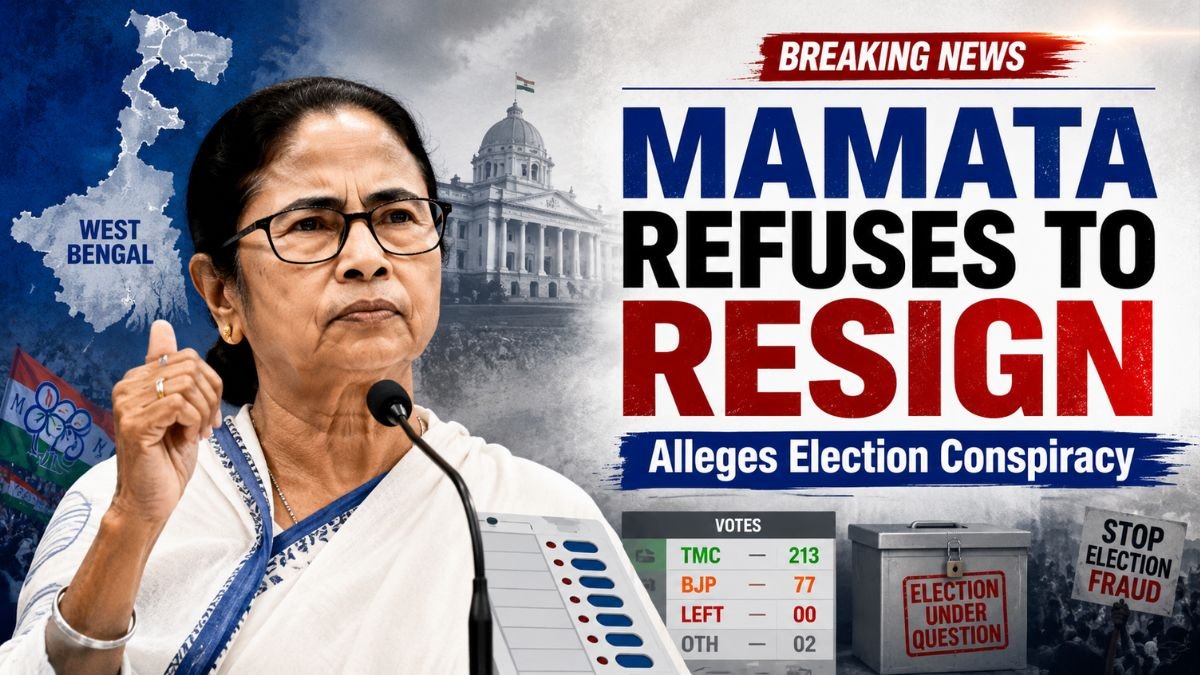
A major political crisis has emerged in West Bengal after Chief Minister Mamata Banerjee refused to resign following her party’s defeat in the state assembly election.
The Bharatiya Janata Party, led nationally by Prime Minister Narendra Modi, won a decisive victory in the state, ending the Trinamool Congress’s long rule.
Banerjee, however, has rejected the result and alleged that the election was not lost through public mandate but through a “conspiracy.”
Her refusal to step down has created a tense political standoff and raised questions about constitutional procedure, democratic norms, and the transfer of power in one of India’s most politically important states. Recent reports say the BJP won 207 of 294 seats, while TMC was reduced to 80.
BJP Scores Historic Win in West Bengal
The BJP’s victory in West Bengal marks a major shift in Indian politics. For years, West Bengal had been one of the most difficult states for the BJP to capture. The TMC, led by Mamata Banerjee, had remained in power for around 15 years and built a strong political base across the state.
According to reported results, the BJP secured a large majority in the 294-member assembly, while the TMC suffered a sharp decline in seats.
The result is being seen as one of the BJP’s most important state-level breakthroughs, especially because West Bengal has long been considered a key opposition stronghold.
The victory also strengthens the BJP’s position nationally, as the party now controls a large number of Indian states.
Mamata Banerjee Rejects the Mandate
After the election results, Mamata Banerjee publicly refused to resign from the chief minister’s post. She claimed that the TMC had not been defeated by voters but by manipulation and conspiracy.
Banerjee alleged that the BJP had “forcefully captured” the election and said the mandate had been “looted.”
She also accused Prime Minister Narendra Modi, Home Minister Amit Shah, and the Election Commission of playing a role in influencing the election process.
Her position has sparked a major debate because, under India’s democratic system, a chief minister is expected to resign once their party loses majority support in the assembly.
Constitutional Crisis in West Bengal
Banerjee’s refusal to step down has raised the possibility of a constitutional crisis. In India, the chief minister must enjoy the confidence of the elected legislative assembly. If the ruling party loses the election, the outgoing chief minister normally resigns and allows the new majority party to form the government.
Reports say the West Bengal governor warned that action could be taken if Banerjee did not voluntarily vacate office. The matter could also move toward legal or constitutional proceedings if the standoff continues.
Legal and political experts are now discussing what happens when a sitting chief minister refuses to follow the usual convention after an electoral defeat.
BJP Calls Refusal an Attack on Democracy
The BJP has strongly criticised Banerjee’s position. Party leaders described her refusal to resign as an attack on democratic tradition and constitutional order.
BJP national spokesperson Sambit Patra reportedly called the move “constitutional blasphemy.” Other BJP leaders also argued that the people of West Bengal had given a clear mandate for change and that the outgoing government must respect the result.
The BJP has also moved to restrict advisers appointed by Banerjee from entering official offices, signalling that the party is preparing for a firm transition of power.
Opposition Leaders Back Banerjee’s Concerns
While the BJP has condemned Banerjee’s refusal, some opposition leaders have supported her criticism of the election process.
Shiv Sena (UBT) leader Sanjay Raut reportedly backed Banerjee’s stand and accused the Election Commission of acting under pressure from the central government.
Banerjee has also warned that the BJP’s growing control over states could push India toward “one-party rule.” She said she would consult other opposition leaders about the next political steps.
This has turned the West Bengal dispute into a broader national debate over election fairness, institutional independence, and the future of opposition politics in India.
What Happens Next?
The next steps may depend on the governor, the courts, and the political response from both parties. If Banerjee continues to refuse resignation, the governor may formally invite the BJP to form the government and take constitutional steps to remove uncertainty.
The situation could also reach the Supreme Court if legal questions arise over the transfer of power. For now, West Bengal remains at the centre of a high-stakes political confrontation.
Conclusion
Mamata Banerjee’s refusal to resign after the West Bengal election defeat has created one of the most dramatic political standoffs in recent Indian politics.
The BJP’s historic win has changed the state’s political landscape, while Banerjee’s allegations of conspiracy have intensified the conflict.
As the governor, courts, and political parties respond, the crisis could become a major test of constitutional procedure and democratic transition in India.