

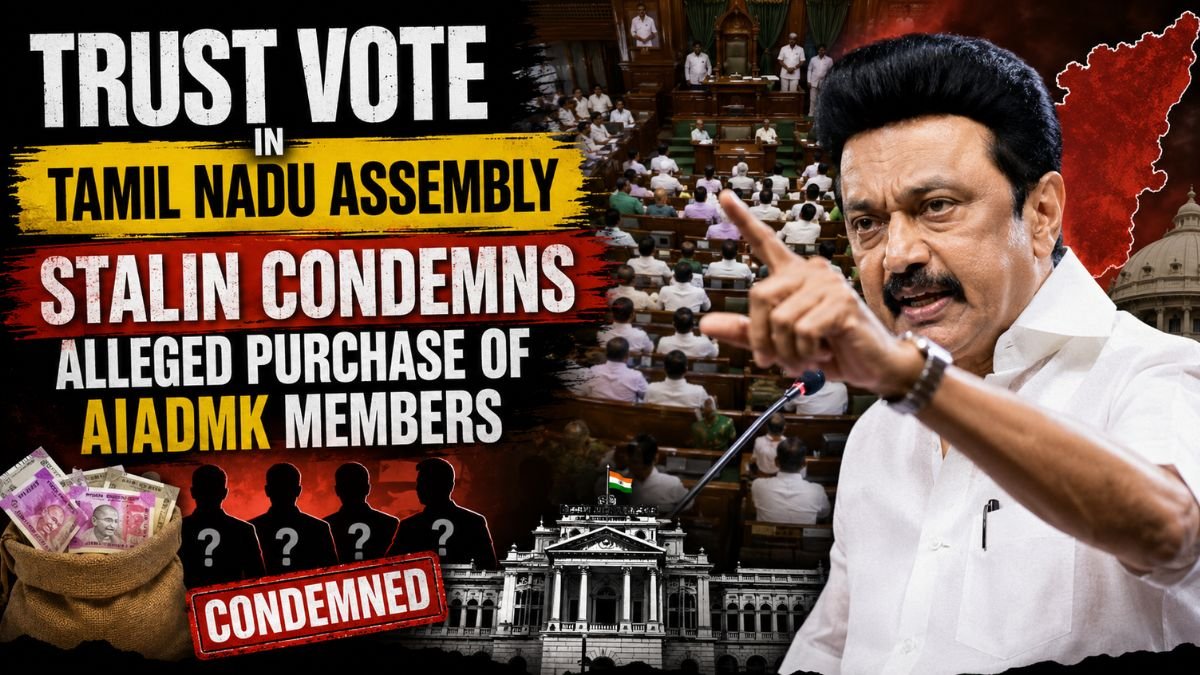
The trust vote in the Tamil Nadu Assembly has triggered a fresh political controversy after DMK president and former Chief Minister M.K. Stalin strongly criticised the alleged purchase of AIADMK members.
Referring to the reported split within the AIADMK, Stalin accused those who had promised “clean politics” of now practicing what he called “dirty politics.”
The controversy comes at a politically sensitive time, as the Assembly trust vote has become a major point of debate in Tamil Nadu politics.
Stalin’s remarks have added further intensity to discussions surrounding the formation of the TVK government and the role of opposition parties in the process.
Stalin Questions Claims of Clean Politics
In his statement, M.K. Stalin said that political leaders who came to power by promising a new model of clean and honest politics were now facing serious allegations.
He suggested that the alleged efforts to influence or purchase AIADMK members exposed a gap between public promises and political actions.
Stalin’s comments were aimed at highlighting what he described as a troubling moment for democratic values in the state.
According to him, the alleged split in the AIADMK was not merely an internal party matter but a larger concern about political morality and transparency.
DMK Boycotts Vote of Confidence
Stalin also explained the DMK’s decision to boycott the vote of confidence. According to the statement, DMK members stayed away from the trust vote in line with the party’s stand that it would not act as an obstacle to the formation of the TVK government.
The DMK leader said the party had taken a clear position and did not want to be seen as blocking the government formation process.
However, he also made it clear that the party would not remain silent on what it considered unfair or unethical political practices.
This position allowed the DMK to distance itself from the trust vote while still raising questions about the political developments surrounding it.
Alleged AIADMK Split Sparks Political Debate
The alleged split in the AIADMK has become one of the central issues in the current political discussion. Stalin’s statement suggested that the reported division within the party may have been influenced by external pressure or inducement.
Such allegations, if proven, could raise serious concerns about the integrity of the legislative process. In any democratic system, a trust vote is expected to reflect the genuine strength of a government on the floor of the Assembly. Claims of political purchase or engineered defections can therefore damage public confidence.
Trust Vote Becomes a Test of Political Ethics
The trust vote was not only a test of numbers in the Assembly but also a test of political ethics. Stalin’s criticism focused less on the arithmetic of the vote and more on the methods allegedly used to secure support.
By using phrases such as “clean politics” and “dirty politics,” Stalin framed the issue as a moral question. He argued that the public deserves political honesty, especially from those who presented themselves as alternatives to traditional power politics.
His remarks are likely to fuel further debate among parties, political observers and voters across Tamil Nadu.
DMK’s Political Message
Through the boycott and Stalin’s statement, the DMK appeared to send two messages. First, it did not want to obstruct the formation of the TVK government. Second, it wanted to register its protest against the alleged political maneuvering involving AIADMK members.
This approach allowed the party to maintain a cautious but critical position. The DMK avoided direct participation in the trust vote but used the moment to question the political conduct of its rivals.
Why the Issue Matters
The controversy matters because public trust in elected representatives depends on transparency and accountability. Allegations of buying support or engineering party splits can create doubts among voters about whether political decisions are being made in public interest or through backroom arrangements.
In a state with a strong political culture like Tamil Nadu, such allegations can quickly become a major public issue.
The trust vote may be over, but the debate around political ethics, party loyalty and democratic responsibility is likely to continue.
Conclusion
The Tamil Nadu Assembly trust vote has opened a new chapter of political tension, with M.K. Stalin condemning the alleged purchase of AIADMK members and accusing rivals of practicing “dirty politics.”
While the DMK boycotted the vote of confidence, Stalin said the party did not want to block the formation of the TVK government.
However, the allegations surrounding the AIADMK split have raised serious questions about political morality and democratic transparency.
As Tamil Nadu politics moves forward, the controversy is likely to remain a key talking point in the debate over clean governance and ethical leadership.