

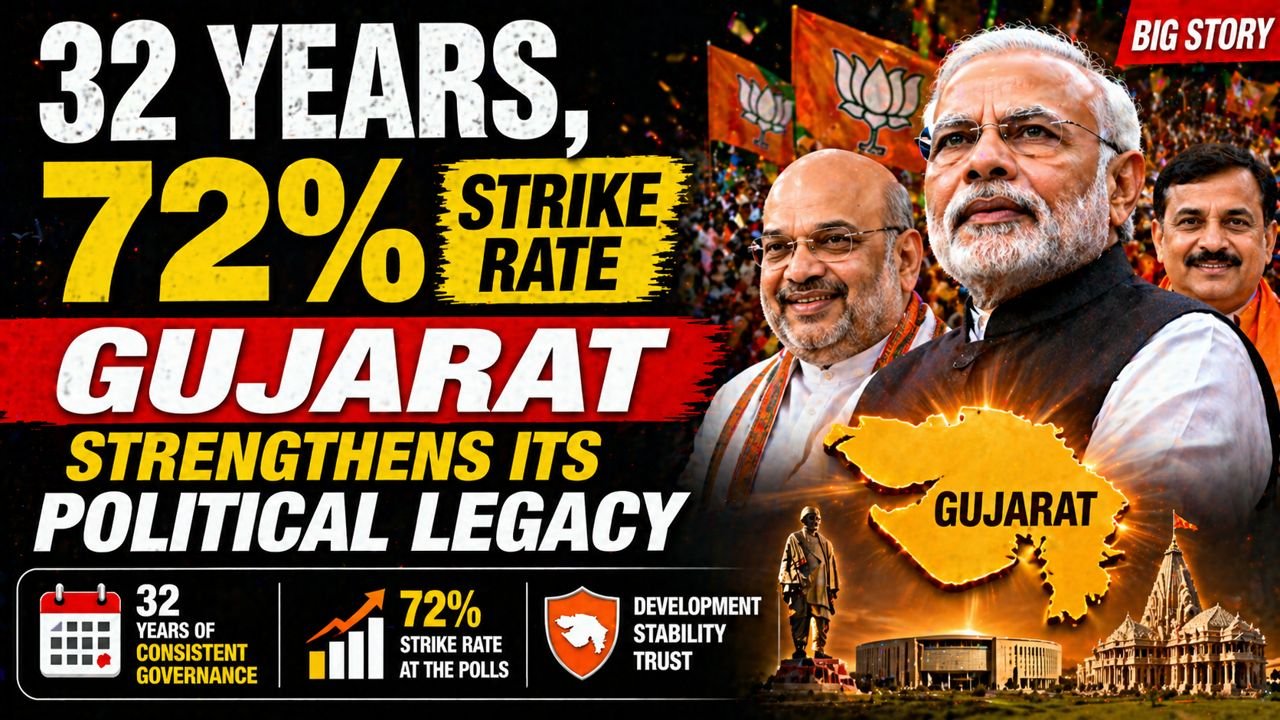
Gujarat has once again reinforced its position as one of India’s most politically consistent states. With an impressive 32-year run in governance and a reported 72% electoral strike rate, the state continues to stand out for its stable political patterns and predictable voting behavior.
This long-standing trend reflects not only strong party organization but also a deep connection between leadership and voter expectations.
A Legacy of Political Stability
For over three decades, Gujarat has largely witnessed continuity in governance, making it a unique case in Indian politics. While many states experience frequent shifts in power, Gujarat’s political environment has remained relatively stable.
The 32-year dominance indicates a sustained level of public trust and organizational strength. It also highlights how consistent policy direction and governance models can influence voter loyalty over time.
Understanding the 72% Strike Rate
The 72% strike rate is a significant indicator of electoral performance. It suggests that a party or political alliance has been able to convert a large percentage of contested seats into victories.
Such a high strike rate reflects:
- Strong booth-level management
- Effective candidate selection
- Consistent voter outreach
- Clear political messaging
This level of performance is not easy to achieve, especially in a competitive democratic environment like India.
Key Factors Behind Gujarat’s Political Strength
Several factors have contributed to Gujarat’s strong political legacy:
1. Organizational Structure
A well-organized political network at the grassroots level has played a crucial role. Strong local leadership ensures better communication with voters.
2. Development-Focused Governance
Infrastructure growth, industrial development, and investment-friendly policies have shaped voter perception over the years.
3. Leadership Influence
Consistent and recognizable leadership has helped maintain voter confidence and stability.
4. Voter Alignment
Over time, a clear alignment has developed between voter expectations and governance delivery.
Impact on National Politics
Gujarat’s political model has often influenced national strategies. The state is seen as a testing ground for campaign techniques, governance models, and electoral strategies.
A strong performance here not only strengthens regional dominance but also boosts confidence at the national level.
Challenges Ahead
Despite its strong track record, Gujarat’s political landscape is not without challenges. Changing demographics, rising urban expectations, and economic pressures could influence future elections.
Opposition parties are also working to expand their presence, which may lead to more competitive contests in the coming years.