

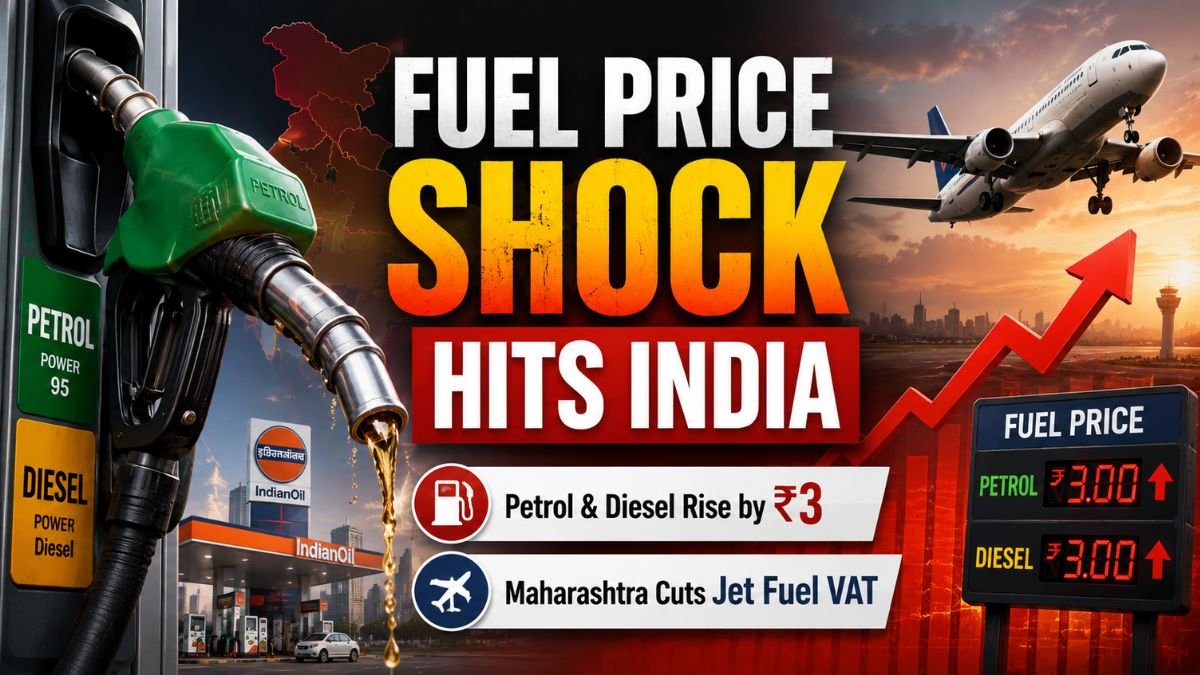
India has seen a major fuel price revision after a long pause, with petrol and diesel prices increased by around ₹3 per litre across the country. The hike came into effect on Friday, May 15, 2026, and marked the first major retail fuel price increase in nearly four years.
The move follows rising pressure from global crude oil prices and mounting losses faced by oil marketing companies.
The increase has directly affected daily commuters, transport operators, delivery services and households already dealing with higher living costs.
While the rise is uniform in broad terms, final pump prices vary across cities because of state taxes, dealer commissions and local levies.
Maharashtra Cuts VAT on Aviation Fuel
Amid the fuel price hike, Maharashtra announced relief for the aviation sector by reducing VAT on Aviation Turbine Fuel from 18% to 7%. The reduction is temporary and will remain in effect for six months from May 15, 2026.
The decision is expected to ease pressure on airlines operating from Maharashtra, especially as jet fuel costs remain a major part of airline expenses.
The aviation sector has been under stress due to higher fuel prices, summer travel demand and uncertainty linked to the West Asia crisis.
City-Wise Petrol and Diesel Rates After Hike
Several major cities reported higher petrol and diesel prices after the revision. In Thiruvananthapuram, petrol rose to ₹110.75, while diesel reached ₹99.63. In Hyderabad, petrol stood at ₹110.89, and diesel reached ₹98.96.
In Bhubaneswar, petrol was reported at ₹104.57, while diesel reached ₹96.11. Bengaluru saw petrol at ₹106.17 and diesel at ₹94.10.
In Noida, petrol stood at ₹98.04, while diesel was priced at ₹91.31. Gurgaon reported petrol at ₹98.29 and diesel at ₹90.77, while Chennai saw petrol at ₹103.90 and diesel at ₹95.47.
Why Fuel Prices Were Increased
The fuel hike comes as state-run oil marketing companies face higher import costs due to elevated global crude prices. India depends heavily on imported crude oil, so any sharp increase in international prices quickly adds pressure to domestic fuel economics.
According to market reports, the ₹3 per litre increase may still be too small to fully cover the losses of oil marketing companies. Some analysts estimated that under-recoveries remain much higher than the latest retail price increase.
Oil Company Shares Fall Despite Price Hike
Shares of major oil marketing companies such as BPCL, HPCL and IOC remained under pressure despite the fuel price increase. Investors appeared concerned that the hike may not be enough to offset the impact of high crude prices and past losses.
This shows that while the price hike may bring some relief to fuel retailers, the broader pressure on the oil sector remains significant.
Export Duty Changes Add Another Layer
India also revised fuel export duties on May 15. Reuters reported that the government raised the export duty on petrol while cutting export duties on diesel and aviation turbine fuel.
These export duty changes are reviewed periodically and depend on international fuel price trends.
Conclusion
The latest petrol and diesel price hike has increased costs for consumers across India, while Maharashtra’s ATF VAT cut offers targeted relief to airlines.
The move reflects the growing pressure from high crude prices, geopolitical uncertainty and financial stress on oil marketing companies.
For consumers, the immediate impact will be higher travel and transport costs. For airlines, Maharashtra’s VAT cut may help control some aviation fuel expenses.
However, if global crude prices remain elevated, further pressure on fuel prices, inflation and transport costs cannot be ruled out.