

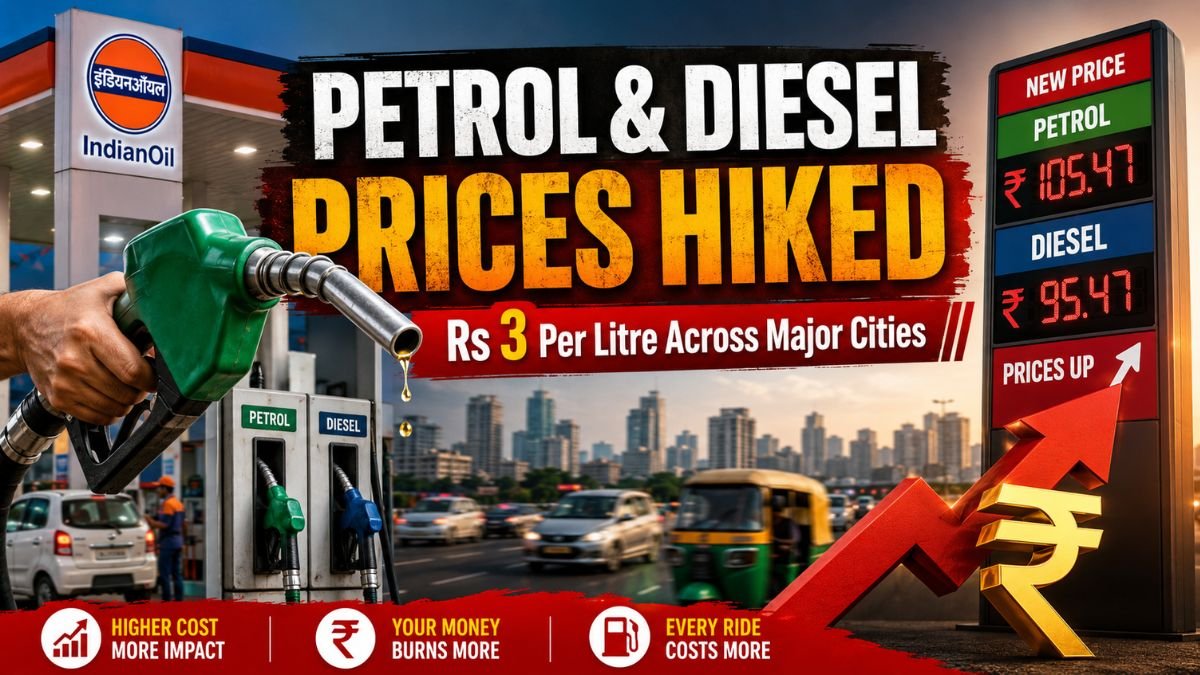
Petrol and diesel prices have been increased by around Rs 3 per litre, pushing fuel rates higher across major Indian cities.
The revised prices came into effect immediately on Friday, adding fresh pressure on commuters, transport operators, and households already dealing with rising costs.
Oil companies announced the price hike amid a sharp rise in global energy prices linked to the ongoing West Asia conflict and concerns over supply disruptions near the Strait of Hormuz.
The government, however, has said there is no fuel shortage in the country and no plan to ration petrol, diesel, or LPG.
New Petrol Prices in Major Cities
The latest revision has pushed petrol prices above Rs 100 per litre in several metro cities. In Delhi, petrol is now priced at Rs 97.77 per litre, up by Rs 3 from the earlier rate of Rs 94.77.
In Kolkata, petrol has increased by Rs 3.29 and now costs Rs 108.74 per litre. Mumbai has also seen a sharp rise, with petrol now priced at Rs 106.68 per litre after a hike of Rs 3.14. In Chennai, petrol has increased by Rs 2.83 to Rs 103.67 per litre.
New Diesel Prices After Hike
Diesel prices have also moved higher across major cities. In Delhi, diesel is now priced at Rs 90.67 per litre, up from Rs 87.67.
Kolkata saw diesel rise by Rs 3.11 to Rs 95.13 per litre, while Mumbai’s diesel price increased to Rs 93.14 per litre. In Chennai, diesel now costs Rs 95.25 per litre after a hike of Rs 2.86.
The increase is expected to affect transport costs, logistics expenses, and possibly the prices of essential goods if higher diesel costs are passed on through the supply chain.
CNG Prices Also Rise
Along with petrol and diesel, CNG prices have also increased in some regions. In Delhi-NCR, CNG prices have gone up by Rs 2, reaching Rs 79.09 per kg. Earlier, Mahanagar Gas Limited had also raised CNG prices by Rs 2 in the Mumbai region.
This means vehicle owners using petrol, diesel, and CNG are all facing higher fuel expenses.
Why Fuel Prices Were Increased
Retail petrol and diesel prices had remained mostly unchanged since April 2022, except for a one-time cut of Rs 2 per litre in March 2024.
State-run oil marketing companies had suspended daily price revisions to protect consumers from earlier global crude price shocks.
However, the recent rise in international crude oil prices has increased pressure on public sector fuel retailers. India imports nearly 90% of its crude oil needs, making domestic fuel prices highly sensitive to global energy market disruptions.
Officials have said the latest price hike is still much smaller than the increase needed to fully offset the rise in global energy costs.
Government Says Fuel Supply Is Sufficient
Despite the price hike, the Centre has maintained that India has enough fuel supplies. Officials have said the country currently has around 60 days of fuel stocks and nearly 45 days of LPG inventories.
Oil Secretary Neeraj Mittal recently said there is no need for panic and no rationing is planned. Oil Minister Hardeep Singh Puri has also stated that India has sufficient reserves to avoid immediate supply disruption.
Conclusion
The latest petrol and diesel price hike of around Rs 3 per litre has raised fuel costs across Delhi, Mumbai, Kolkata, Chennai, and other cities.
The move comes amid rising global crude oil prices, West Asia tensions, and growing pressure on oil marketing companies.
While the government has assured that fuel supplies remain stable, consumers may now face higher daily travel and transport costs.
If global crude prices remain elevated, fuel pricing could continue to remain a key concern for households, businesses, and the wider economy.