

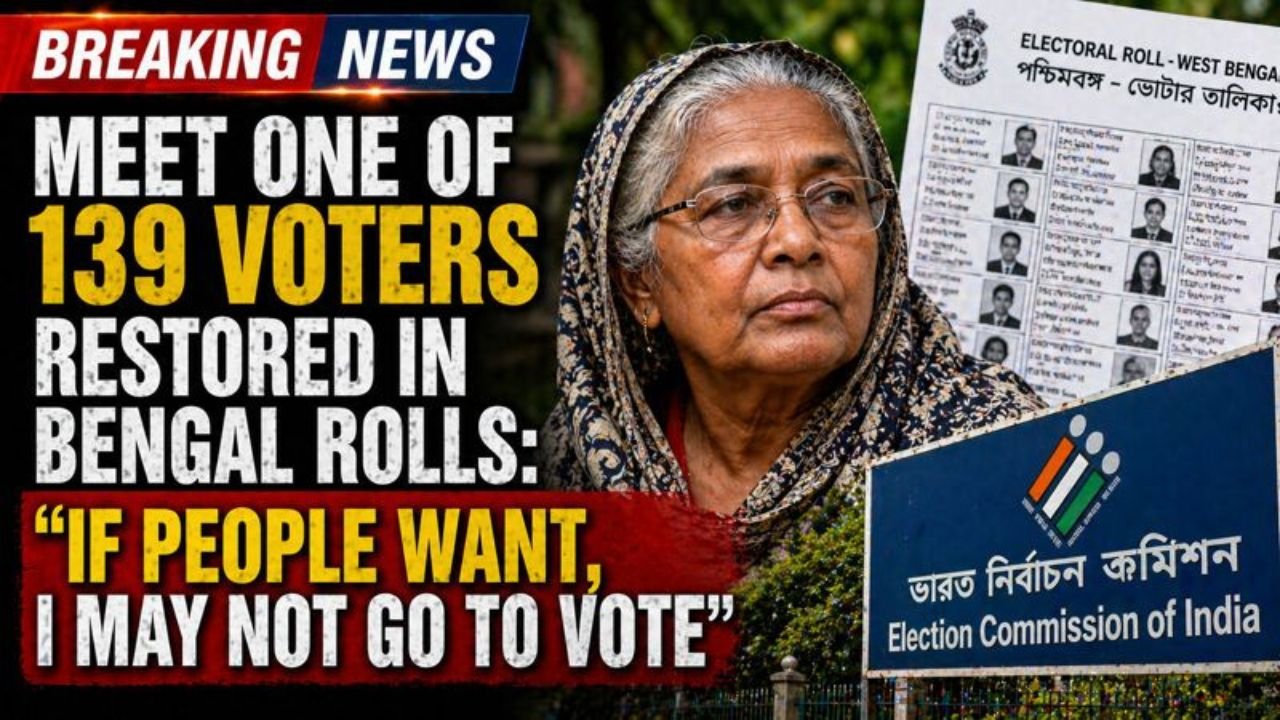
The story behind “Meet One of 139 Voters Restored in Bengal Rolls” highlights a deeply personal side of democracy that often goes unnoticed. While election headlines usually focus on big political parties and leaders, this situation brings attention to ordinary citizens whose voting rights were once removed and later restored. For many, the right to vote is not just a duty but also a symbol of belonging and identity.
In this case, one of the 139 voters restored in the electoral rolls of West Bengal has shared a surprisingly emotional and thoughtful response. Instead of celebrating the return of voting rights, the individual expressed hesitation, saying that if people around them do not support it, they might choose not to vote. This reaction opens a discussion about social influence, personal choice, and the meaning of participation in democracy.
A Personal Perspective: “If People Want, I May Not Go to Vote”
Social Influence on Voting Decisions
The most striking part of “Meet One of 139 Voters Restored in Bengal Rolls” is the voter’s statement about possibly not voting. This highlights how personal decisions are often influenced by community opinions. In many parts of India, voting is not just an individual act but also a social one.
The voter’s words suggest that they value the opinions of people around them. This could be due to cultural norms, local pressures, or a desire to maintain harmony within the community. It shows that even when rights are restored, participation is not always guaranteed.
Emotional Impact of Losing and Regaining Rights
Being removed from the voter list can feel like losing a voice. When that right is restored, it can bring relief but also mixed emotions. The individual in this story does not react with excitement but instead reflects carefully on whether to participate. This emotional response adds depth to the narrative of “Meet One of 139 Voters Restored in Bengal Rolls”.
The Broader Context of Elections in West Bengal
Political Environment and Public Sentiment
West Bengal is known for its active political environment, where elections are often closely watched. In such a setting, the restoration of voters becomes a significant issue. It raises questions about fairness, accountability, and the role of institutions.
Importance of Trust in the System
For democracy to function smoothly, people must trust the system. When names are removed without clear reasons, it can create doubt. The restoration process helps rebuild that trust, but it also shows the need for better systems to prevent such issues in the future.
Complete Overview in Simple Table Format
| Topic | Simple Explanation | What It Means for People |
|---|---|---|
| 139 Voters Restored | Some people were removed from voting list by mistake and later added back | Their voting rights are returned |
| Reason for Removal | Errors, wrong data, or confusion in records | Shows system is not perfect |
| Restoration Process | Authorities checked and corrected the list | Government fixing mistakes |
| Voter Reaction | One voter said they may not vote if others don’t want | Social pressure affects decisions |
| Importance of Voting | Voting gives people power to choose leaders | Every vote matters in democracy |
| Emotional Impact | Losing voting rights feels bad, getting it back feels mixed | People feel confused or unsure |
| Public Trust | People need to believe the system is fair | Trust is important for elections |
| West Bengal Context | State has strong political activity | Every vote becomes important |
Challenges Highlighted by This Case
Administrative Errors and Their Impact
The issue described in “Meet One of 139 Voters Restored in Bengal Rolls” shows how small administrative mistakes can have big consequences. Even a single missing name can prevent someone from participating in the democratic process.
Awareness Among Voters
Another challenge is awareness. Many people may not even know that their names have been removed until election time. This makes it important to check voter status regularly and stay informed.
The Role of Individual Choice in Democracy
Freedom to Vote or Not to Vote
One of the key takeaways from “Meet One of 139 Voters Restored in Bengal Rolls” is that democracy includes the freedom to choose whether to vote. While voting is encouraged, it is ultimately a personal decision.
Influence of Community and Society
In many cases, people look to their community before making decisions. This can strengthen unity but may also limit individual expression. The voter’s statement reflects this balance between personal choice and social influence.