

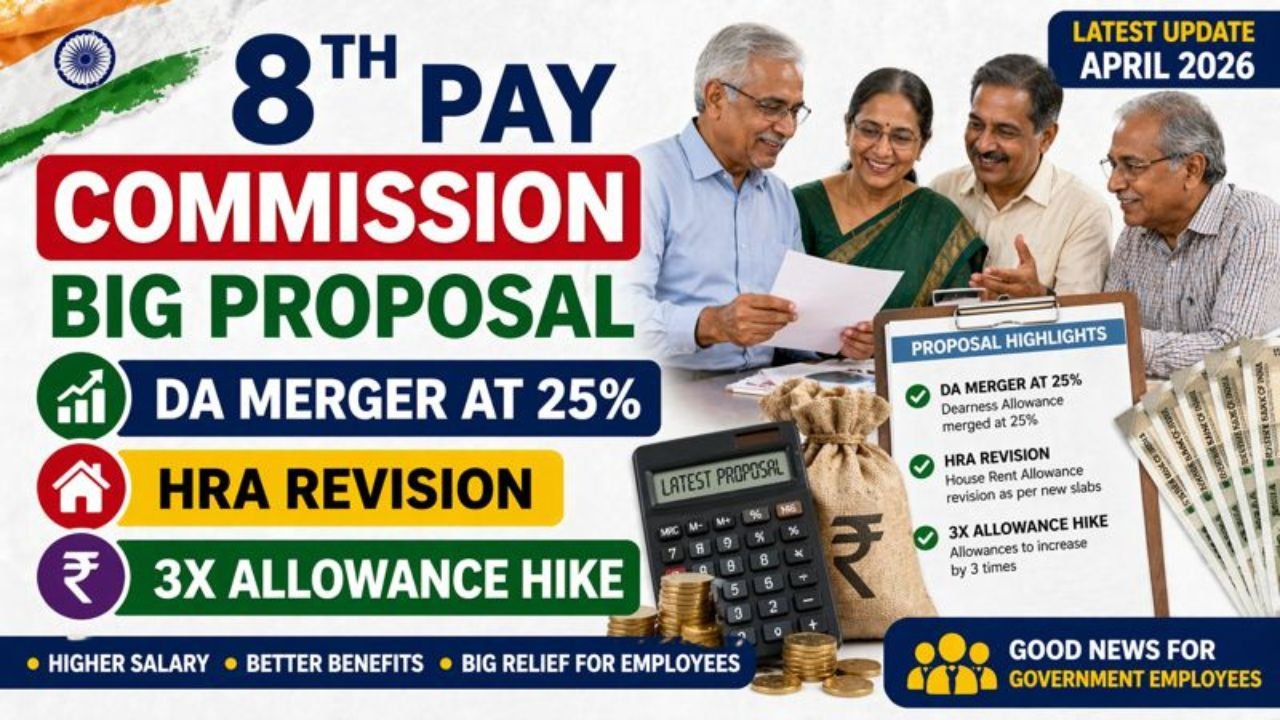
The discussion around the 8th Pay Commission proposal is gaining attention across India, especially among government employees and pensioners. The latest updates suggest major financial changes that could directly impact salaries, allowances, and overall income. These proposed reforms include merging Dearness Allowance at 25%, revising House Rent Allowance, and increasing other allowances up to three times. This article explains everything in simple language so that anyone can easily understand what these changes mean and how they might affect daily life.
What is the 8th Pay Commission and why it matters
The 8th Pay Commission proposal is expected to follow the previous pay commissions that are formed by the Indian government to revise salaries of central government employees. These commissions usually come every 10 years and aim to adjust salaries based on inflation, cost of living, and economic conditions.
Understanding DA merger at 25%
Dearness Allowance is a cost-of-living adjustment paid to government employees. It is revised regularly to match inflation. According to the 8th Pay Commission proposal, once DA touches 25%, it may be merged with the basic salary.
This means that instead of being a separate component, DA will become part of the basic pay. When this happens, the basic salary increases automatically, which also impacts other benefits like pension, gratuity, and allowances.
For example, if someone has a basic salary of ₹20,000 and DA reaches 25%, the new basic salary after merging would become ₹25,000. This leads to higher overall earnings and long-term benefits.
HRA revision explained in simple terms
House Rent Allowance is given to employees to help cover rental expenses. The 8th Pay Commission proposal includes a revision in HRA rates based on the DA merger.
Currently, HRA is calculated as a percentage of basic salary depending on the city category. With the increase in basic salary after DA merger, HRA will also increase. This helps employees manage higher rent costs in cities.
The revision may follow a pattern where HRA percentages change depending on DA levels. When DA crosses 25%, HRA rates may also be adjusted upward, leading to better housing support.
Allowance hike up to 3 times
One of the most talked-about parts of the 8th Pay Commission proposal is the increase in allowances. Reports suggest that certain allowances could rise up to three times their current value.
Allowances include travel allowance, medical allowance, children education allowance, and more. These are essential for covering daily and lifestyle expenses. A threefold increase can significantly improve the financial stability of employees.
For instance, if a particular allowance is currently ₹2,000, it could increase to ₹6,000 after revision. This directly boosts take-home income without increasing workload.
Full details in simple table format
| Topic | Current Situation | Proposed Change | Simple Meaning |
|---|---|---|---|
| Dearness Allowance (DA) | Given separately and increases over time | Will merge with salary at 25% | Salary will increase directly |
| Basic Salary | Fixed base pay | Will increase after DA merge | Higher income and benefits |
| House Rent Allowance (HRA) | Based on city and salary | Will increase after salary revision | Better support for rent |
| Allowances | Fixed amounts | Can increase up to 3 times | More money for daily expenses |
| Pension | Based on basic salary | Will increase with new salary | Higher pension after retirement |
| Overall Salary | Limited growth | Significant increase expected | Better financial condition |
Impact on employees and pensioners
The changes proposed in the 8th Pay Commission proposal are expected to benefit both working employees and retired pensioners. When the basic salary increases due to DA merger, pension calculations also improve. This ensures that retirees receive higher monthly income.
Employees working in cities with high living costs will benefit more due to HRA revision. Similarly, the allowance hike will help manage rising expenses like education, travel, and healthcare.
When can these changes be expected
Although the 8th Pay Commission proposal has created excitement, it is important to note that these are still proposals and discussions. The government has not officially confirmed the implementation timeline.
If approved, the commission could be formed soon, and recommendations may take some time to be implemented. Usually, such changes take a few years to come into effect.
Conclusion
The 8th Pay Commission proposal brings hope for a major salary revision for government employees in India. The idea of merging DA at 25% into basic pay, revising HRA, and increasing allowances up to three times can significantly improve financial conditions. These changes not only increase monthly income but also strengthen long-term benefits like pension and savings. While official confirmation is still awaited, the proposal clearly shows the government’s focus on supporting employees against rising living costs. If implemented, it could become one of the most impactful salary reforms in recent years.